Showing posts with label ALDI. Show all posts

Monday, 5 September 2016

Vegetable spaghetti - make your own!

Hubbie and I love courgettes but my son isn't keen on the texture. The taste is fine, just the texture makes him gurn. So, we've been experimenting with different ways of using courgettes to try and alter how they taste. Sliced, cubed, boiled, stir fried: nothing quite did the trick, until we found courgette spaghetti!


Occasionally we saw pots of various vegetables spaghettified on the reduced to clear rack at the end of the day, and if they were 20-25p a pot max then we'd pick them up to try. Luckily they do freeze well so it's worth doing, and we found that the spaghettification didn't make son and heir pull faces!

But then we got to wondering about the cost of them if bought at full price, e.g. Tesco's courgette spaghetti is £1 for a 250g tub. So how does 250g compare to a whole courgette?

We buy our whole courgettes in ALDI in packs of three for around 79p normally, but this week they are on special offer at 49p for three. So we bought 2 packs, and they are nice sized ones too!  A quick check on the scales informed us that each courgette averages just over 300g, so that's 20% more than in the ready spaghettified pot from Tesco, even allowing for taking off the stalk bit and the flower tip. A whole £1 for less than one spaghettified courgette - sheesh!

Ahhh, I can hear you thinking, but yours is whole and the Tesco one is spaghettified, and it's probably faffy, takes a while and needs an expensive gadget to make courgetti...  but you'd be wrong! It's incredibly simple and takes less than 5 minutes to spaghettify a whole courgette - yes, less than 5 minutes... and the gadget isn't expensive either.

Well it could be if you wanted one of the posh spiralisers especially if it has a name endorsing it, but you can pick them up in cookware shops for under a tenner still. Meanwhile, I found my gadget whilst rummaging in the kitchen drawer for something else.  I'd picked it up somewhere way back when, and I thought it was a fancy kind of potato peeler, but soon found out it wasn't. Not able to work out what to do with it, I tossed it in the bits and bobs drawer and forgot all about it... until recently!

Now if you are a Lancashire woman like me, you'll be familiar with a Lancashire peeler for vegetables, which is nothing like those funny Y-peelers used across the Pennines in Yorkshire or elsewhere in the world. Using my forgotten gadget was simplicity itself!


It's a wee French thing, stamped  INOX fabrication l'avare depose le rap legumes around its rippled cutting blade. It works just like a Lancashire peeler but instead of having a straight slit to scrape off the peel, it has a wavy edged slit to make narrow strips: you scrape it along the courgette to make lengths of courgetti. I find it easier to cut the courgette in half across the middle as that way it's easier to hold them and the lengths aren't too lengthy, if you get my drift! One courgette takes only a few minutes to spaghettify (less than five) and costs a lot less than £1!  In true "Blue Peter" fashion, here's one I made earlier.


My INOX gadget is probably no longer made, but if you do happen across one, pick it up and add it to your kitchen toolbox, it's a really neat and simple to use piece of kit!

Wednesday, 18 November 2015

No need bread!

"What do you mean, no need bread? Of course we need bread!" was our response to this. It soon became apparent that it wasn't no need, but was in fact no-knead, bread!


A friend over on Facebook was explaining that her hubbie had become smitten with bread-making after finding the no-knead bread method, so we decided we had to check this out for ourselves. Armed with the link we watched the video tutorial on TimesVideo and then wrote out the basic recipe and headed for the kitchen... the recipe comes from Jim Lahey at the Sullivan Street Bakery in Manhattan (USA) and uses just flour, water, yeast and salt... and no kneading!

Here is the basic recipe we used:

3 cups plain flour (not strong or bread flour, just normal plain flour)
¼ teaspoon of dried yeast (ours is The Pantry own brand from ALDI)
1¼ teaspoons salt
1½ cups tepid water

Put the flour, yeast and salt in large bowl, mix together. Make a well in the centre of the dry mix, pour in the water, mix the dry stuff into the water until it makes a dough. In the video Jim used his hands for this, but we found it was a claggy sticky process, so experimented a bit and found a flat bladed dinner knife worked best as a mixing tool.  It only took a minute or two to mix, so not too onerous.

Once the dough was well mixed, we put the bowl into a warm spot - we set ours on a chair next to the radiator - with a towel wrapped round the bowl, and a clean tea towel over the top, then to keep in the heat we spread 3 or 4 more thick hand towels over the top of the bowl so the top and sides were well-covered.

We left the covered bowl in its warm spot for around 14 hours, then cautiously lifted the covers and peered inside. The dough was beautifully bigger! At least twice the size, heading for three times the size of the original dough.

Next we pre-heated the baking tin. We used a very heavy 10" diameter Le Creuset casserole pan with lid, a gentle wipe round the inside of the pan with a bit of olive oil on some kitchen roll just to prevent sticking, then we popped the pan (without its lid) into the oven and let it heat up. The oven was on maximum - the video says 500F degrees, but ours only goes to Gas Mark 8 which is around 450F degrees but what the heck! We left the pan to heat up for around 15 minutes.

Meanwhile the dough was lifted from the bowl and put onto a floured board and made into a ball shape, then flattened a bit, folded over, dusted with flour, turned upside down and dusted again with flour, then dropped into the pre-heated oven pan, and the lid popped on.

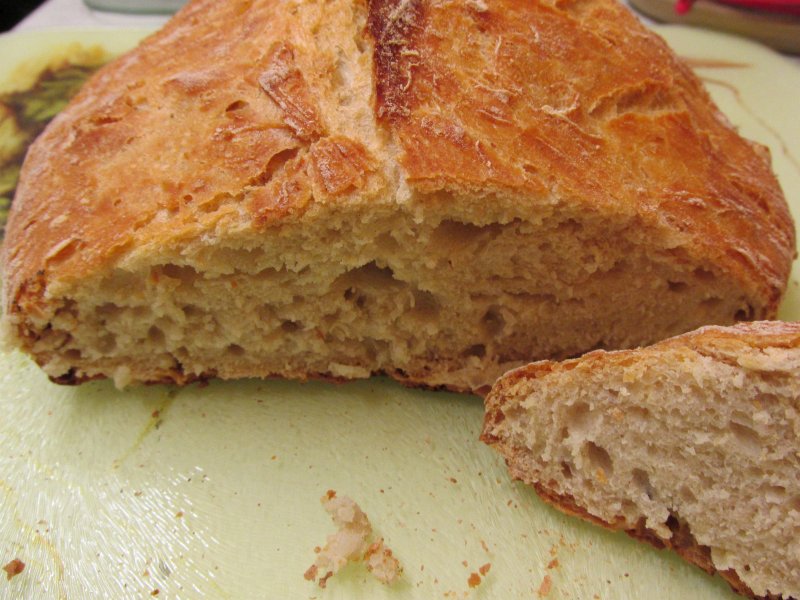
Back into the oven it went, still on full, for around 55 minutes. In fact we should have lifted the lid after about 30 minutes and finished it off open topped, but we forgot to do that! It obviously didn't do any harm, as when we lifted the pan from the oven and removed its lid, the bread looked amazing!

After letting it cool enough so the heat didn't fog the camera lens, we took photos, and then sampled it. What wonderful bread! It would be fab with home-made soup, but very enjoyable as I had it, just smeared with butter.

Our next attempt will involve a double quantity, a much larger baking pan, and possibly sun-dried tomatoes and olives... watch this space!


 Edited to add for clarity: Gas Mark 8 equates to 450 degrees Fahrenheit or 230 degrees Celsius

Sunday, 8 November 2015

Oops! No instructions... how do I mix this marinade?

You know that moment when you decide you are going to use something from your pantry and then realise that you have no instructions as to how to use it? Well I had one of those a couple of days ago... in my case it was with some Flava-It Chinese Marinade packets which my son and I had happily emptied from packets into a airtight storage jar on the spice shelf whilst sorting out said pantry a week ago.

It's been a while since I'd used the Marinade last, and I had a vague memory that it used something like yoghurt to mix with the marinade powder to make the coating, but I wasn't sure. Another problem is that said son is currently on a dairy free diet for a couple of months, so yoghurt as a mixer was out of the question. So what to use instead? Water would be too thin, so I tried ALDI's Acti Leaf sweetened soya milk instead. Mixing a couple of tablespoons of the marinade powder into a cup of soya milk, and then poured into a plastic tray into which I popped the pork ribs to be marinaded, wrapped the whole tray in foil, put it in the fridge overnight, and forgot about it!

We had intended to have the ribs the following night, but we were sidetracked by some gorgeous smoked river cobbler and some chilli, ginger and lime mackerel, which soon became a rather delicious rice and fish dish. Meanwhile our ribs were still happily marinading in the fridge. Realising it was a use it or lose it moment tonight, I brought out the tray, removed the foil, not sure how the soya milk would have worked, and was astonished to find the ribs looked really well marinaded. The smell was good too, so I transferred them to a rack over a deep tray and into the oven they went, on Gas mark 6 for around 35 minutes, turned after 20 minutes so both sides cooked evenly.

I have to say that they were gorgeous when cooked. Leaving them to marinade for that bit longer really helped the flavour to infuse through all of the meat, and it proved that sweetened soya milk is a perfectly good substitute for yoghurt, or whatever it was I was supposed to have used!

Moral of the tale is: don't be afraid to experiment!

Tuesday, 29 September 2015

Bacon and vegetable rice - all in one recipe!


We recently bought a Paella pan from ALDI, and it is the most useful piece of kit!  It's quite big at 39cm diameter, and makes a meal large enough for 4 people. It's now in regular use, several times a week, and we are loving the results. Despite its size it cooks nicely over one gas ring, but would work just as well on an electric hob.  

Tonight's meal is shown above and was made as follows:

Bacon and vegetable rice

250g of Arborio rice
1 litre of vegetable stock (1 litre water and 2 veg stock cubes and 1 green OXO)
1 200g pack ALDI Smoked Bacon Lardons 
1 onion chopped finely
3 cloves garlic, crushed
3 or 4 sticks of celery, cut small - we used the middle part with the leaves still on
1 courgette, sliced into 4 lengthwise and then each length cut into 1cm pieces
1 small orange pepper, deseeded
1/2 red pointed pepper, deseeded
handful of frozen sweetcorn
small handful of mangetout and fine French beans, chopped into 1cm lengths
1 finely sliced lemon grass stick
a few green olives, halved
1 small green bird's eye chilli, finely sliced
sprinkle of herbs (we used Herbes de Provence) 
6 cherry tomatoes, halved

Put rice into paella pan, add stock, sweetcorn and bacon lardons, and stir using a non-scratching spatula (wood or silicon), heat through until rice is almost cooked, adding more boiling water as the stock is absorbed so the rice does not start to stick to the pan.  Cooking the bacon lardons with the rice and stock gives the rice a lovely bacon flavour too. 

Add the rest of vegetables except tomatoes, mixing well and cook for further 5 minutes until all is hot through. Add the tomatoes and heat for another minute. 
Serve in bowls, enjoy! 

It takes about half an hour to make (including preparation) and makes hardly any washing up too, win! win! :)